Physician-Scientist · Urologic Oncology & Translational Cancer Research

Xingyu Chen

MD, MSc
Decode cancer ecosystems. Perturb causal mechanisms. Translate discoveries into therapies.

My primary clinical and scientific focus is urologic oncology—particularly bladder and urothelial cancer—while my research extends across broader solid tumors, tumor immunology, and immune-cell therapy. I integrate clinical medicine with cancer genomics, tumor immunology, artificial intelligence, functional genomics, and single-cell & spatial multi-omics to uncover mechanisms of progression, immune escape, therapeutic resistance, and clinically actionable vulnerabilities.

PRIMARY FOCUS Urologic Oncology · Urothelial Cancer · Precision Cancer Medicine | Broader scope: solid tumors · tumor immunology · CAR-T
Cancer Genomics Tumor Immunology AI & LLMs Functional Genomics Single-Cell Spatial & 3D Biology
Urologic OncologyBladder & urothelial cancer
Nature-family × 4Mechanism · immunity · systems biology
U.S. PatentAI radiogenomics
Translational ScopeMechanism → therapy
Portrait of Xingyu Chen
4 Nature-family research articles
1,063 Google Scholar citations · Aug 2026
Scholarly Impact Google Scholar · Aug 2026
1,063Citations
17h-index
20i10-index
Research Output Peer-reviewed research
26Publications
12Lead-author papers
4Nature-family articles
Scientific identity

From clinical question to mechanism to therapy.

My goal is not to specialize in one technology. It is to choose and integrate the right clinical, computational, and experimental approaches to answer important biological questions.

I am a physician-scientist whose primary disease focus is urologic oncology, especially bladder and urothelial cancers, with a broader research program spanning solid tumors and immune-cell therapy. I work at the intersection of clinical oncology, cancer genomics, tumor immunology, artificial intelligence, functional genomics, and single-cell & spatial systems biology.

My research starts from clinically meaningful problems encountered in oncology—why tumors recur, progress, evade immunity, or resist therapy—and connects patient cohorts with high-dimensional molecular profiling, computational modeling, functional perturbation, and mechanistic validation. Urologic cancers provide a central clinical framework for this work, while the underlying biological questions extend across cancer types.

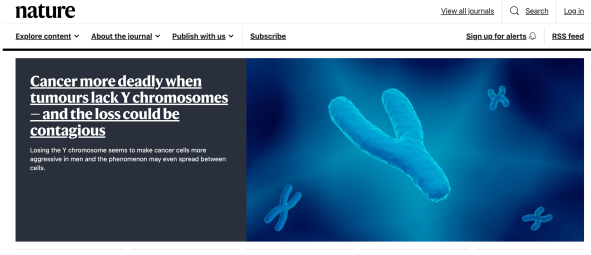
A major focus of my work has been loss of the Y chromosome (LOY). In a co-first-author Nature study in 2023, we established a causal link between Y-chromosome loss in cancer cells, adaptive immune evasion, and response to immune-checkpoint blockade. In a first-author Nature study in 2025, I led pan-cancer analyses integrating more than one million single-cell profiles and clinical cohorts across 29 cancer types to reveal coordinated LOY across tumor and immune compartments and its impact on patient outcome.

My work also spans T-cell exhaustion and differentiation, AI-enabled radiogenomics, immunotherapy biomarkers, and current efforts in CAR-T systems biology and perturbational genomics. Across these projects, I aim to move from descriptive molecular associations toward causal mechanisms and actionable therapeutic hypotheses.

Clinical observation → study design → multi-omics discovery → AI modeling → functional perturbation → mechanism → therapeutic translation.
Research philosophy

Decode. Perturb. Translate.

Three connected research pillars organize my work across urologic oncology, pan-cancer biology, computational science, functional genomics, and therapeutic translation.

01 / DECODE

Cancer ecosystems

Resolve how genomic alterations and multicellular states shape tumor evolution, immunity, and treatment response across patients.

Cancer genomicsscRNA/scATACSpatial omics3D biology
02 / PERTURB

Establish causality

Use genetic perturbation, regulatory modeling, and AI-enabled in silico experiments to distinguish causal drivers from molecular correlation.

CRISPR screeningPerturb-seqVirtual KOFoundation models
03 / TRANSLATE

Improve therapy

Connect mechanism to biomarkers, therapeutic targets, rational combinations, and clinically relevant strategies for precision oncology.

BiomarkersDrug combinationsImmunotherapyClinical translation
Primary disease focus

Urologic oncology as the clinical anchor of my research.

My strongest disease-specific body of work is in urologic malignancies—particularly bladder and urothelial cancer—where I have built a sustained research trajectory across tumor immunology, radiogenomics, treatment-response biomarkers, clinical translational studies, and precision oncology.

Nature · Co-first authorMechanistic link between Y-chromosome loss, immune evasion, and checkpoint-blockade response in bladder cancer.
AI RadiogenomicsMRI + RNA-seq framework for muscle-invasive bladder cancer staging and precision risk assessment.
U.S. Patent ApplicationRadiogenomic approach arising from translational bladder-cancer research.
Clinical Biomarker StudiesNAC response, survival stratification, immune-state and treatment-response biomarkers in urothelial cancer.
Bladder cancer · tumor immunology

Immune-state and checkpoint-response biomarkers in bladder cancer

My early first/co-first-author work defined CD8⁺ T-effector, immune-checkpoint, pyroptosis, and tumor-microenvironment programs associated with prognosis and immunotherapy response in bladder cancer, establishing the clinical and biological foundation for my later work on tumor–immune co-evolution.

Representative publications: Oncogene 2021 · Frontiers in Immunology 2021
Bladder cancer · mechanism & immunotherapy

Y-chromosome loss as a causal driver of immune evasion

In a co-first-author Nature study, I helped connect a genomic alteration observed in bladder cancer to altered T-cell states, adaptive immune escape, clinical outcome, and differential sensitivity to immune-checkpoint blockade—illustrating a direct path from human tumor genomics to mechanism and therapeutic relevance.

Nature 2023 · Co-first author
Precision staging · AI radiogenomics

MRI + RNA-seq + AI for muscle-invasive bladder cancer

I co-developed radiogenomic approaches integrating quantitative MRI and tumor transcriptomics for more accurate staging and risk assessment in muscle-invasive bladder cancer. This work contributed to a U.S. patent application and reflects my interest in translating computational models into clinically useful tools.

International Journal of Molecular Sciences 2024 · U.S. Patent Application No. 2024/0360518
Clinical translation · treatment stratification

Molecular stratification of patients receiving neoadjuvant chemotherapy

My clinical translational work includes qPCR-based survival stratification in NAC-treated muscle-invasive bladder cancer and upper-tract urothelial carcinoma projects focused on treatment response and outcome prediction—bridging molecular profiling with real-world therapeutic decision making.

Journal of Translational Medicine 2026 · First-author clinical translational research
Selected research contributions

Disease-focused depth, pan-cancer reach, and translational impact.

Urologic oncology is the clinical anchor of my work; the same computational, immunologic, and functional frameworks extend across pan-cancer biology and cell therapy.

Tumor–immune co-evolution
Nature · 2025
FIRST AUTHOR

Concurrent loss of the Y chromosome in cancer and T cells impacts outcome

I developed and led a pan-cancer framework integrating bulk tumors, paired tumor–blood cohorts, more than one million single-cell profiles, and spatial analyses across 29 cancer types. The work expanded LOY from a tumor-cell alteration into a feature of the broader tumor–immune ecosystem.

Pan-cancer genomics>1M single cellsSpatial biologyClinical outcome modeling
View publication →
Mechanism & immunotherapy
Nature · 2023
CO-FIRST AUTHOR

Y chromosome loss drives growth by evasion of adaptive immunity

Co-led human single-cell, clinical-cohort, and translational analyses linking Y-negative tumors to altered T-cell states, immune escape, adverse outcome, and enhanced sensitivity to immune-checkpoint blockade.

Human cohortsSingle-cellMouse modelsCheckpoint blockade
View publication →
Systems immunology
Nature · 2025

Proteotoxic stress response drives T cell exhaustion and immune evasion

Led pan-cancer human single-cell dataset assembly, integrative analysis, and immunotherapy-cohort validation connecting stress programs with T-cell exhaustion and therapy resistance.

Pan-cancer scRNA-seqT-cell statesImmunotherapy cohorts
View publication →
T-cell regulatory biology
Nature Immunology · 2026

ZFP148 is a transcriptional repressor of cytolytic effector CD8⁺ T-cell differentiation

This work extends my research from observational immune states toward functional regulation of cytotoxic T-cell differentiation and supports my growing focus on perturbational genomics.

CD8⁺ T cellsTranscriptional regulationFunctional genomics
View publication →
Urologic oncology · precision medicine
AI · Patent · Clinical cohorts

A sustained translational program in bladder and urothelial cancer

My urologic-oncology research integrates bladder and urothelial cancer cohorts with MRI, RNA-seq, machine learning, tumor-immune signatures, treatment-response modeling, and mechanistic tumor-immunity studies. This body of work spans immunotherapy biomarkers, neoadjuvant-treatment stratification, AI radiogenomics, and a U.S. patent application—forming the disease-specific foundation of my broader translational cancer research.

MRI + RNA-seqMachine learningMIBCImmunotherapy biomarkersPrecision staging
View radiogenomics paper →
Clinical translational study
J Transl Med · 2026

qPCR-based survival stratification in NAC-treated muscle-invasive bladder cancer

A clinically focused gene-signature study connecting molecular profiling with outcome stratification in patients receiving neoadjuvant chemotherapy.

Clinical cohortsqPCRNACSurvival stratification
Current flagship program

CAR-T systems biology & functional genomics.

Connecting patient-derived single-cell states with response, epigenetic regulation, functional perturbation, and AI-enabled causal prioritization.

Building a cross-cancer CAR-T atlas

From millions of CAR-T cells to causal regulators of immune function.

I am building a harmonized single-cell CAR-T resource spanning hematologic malignancies and solid tumors, multiple treatment stages, disease contexts, and—across most cohorts—clinical response annotations. The resource is designed not simply for descriptive atlas building, but as a foundation for functional interrogation of the cellular programs that determine CAR-T expansion, persistence, cytotoxicity, signaling, differentiation, and dysfunction.

I integrate the patient-derived atlas with CRISPR screening, Perturb-seq, regulatory-network inference, virtual knockout, in silico perturbation, and genomic foundation models to investigate how epigenetic and transcriptional regulators shape immune-cell function and therapeutic response.

>20single-cell studies
>300patients
Millionsof single cells
>10cancer types
Heme + Solidmalignancies
Most cohortswith response annotation
01 · BUILDPatient CAR-T atlasCross-study harmonization and longitudinal cell states
02 · DISCOVERResponse programsExpansion, memory, cytotoxicity, dysfunction
03 · MODELRegulatory networksEpigenetic and transcriptional regulators
04 · PERTURBCRISPR & Perturb-seqFunctional evidence at single-cell resolution
05 · SIMULATEVirtual perturbationIn silico KO and foundation-model prioritization
06 · VALIDATECausal mechanismsPrioritize experimentally testable regulators
07 · TRANSLATEOptimize therapyPersistence, function, and therapeutic response
How I approach a research problem

A translational workflow built around the patient.

Technology is selected to answer the biological and clinical question—not the other way around.

01

Clinical Question

Unmet need, response, resistance, progression

02

Study Design

Cohorts, longitudinal samples, clinical endpoints

03

Deep Phenotyping

Genomics, single-cell, spatial & 3D biology

04

AI & Modeling

ML, LLMs, foundation models, networks

05

Perturbation

CRISPR, Perturb-seq, virtual KO

06

Mechanism

Cell states, interactions, causal regulators

07

Translation

Targets, biomarkers, combinations, clinical hypothesis

Integrated capabilities

Clinical depth + computational breadth + functional validation.

My strength is the ability to connect these domains into one coherent research program.

01

Urologic & Translational Oncology

Urologic oncology, clinical question formulation, patient cohorts, longitudinal outcomes, biomarker development, treatment response and resistance, translational study design.

Primary disease focus: bladder & urothelial cancer
02

Computational Biology & AI

R, Python, Linux, machine learning, deep learning, LLM-assisted research workflows, genomic foundation models, reproducible large-scale analysis.

AI as an active scientific tool, not a label
03

Single-Cell, Spatial & 3D Biology

sc/snRNA-seq, scATAC-seq, spatial transcriptomics and proteomics, CosMx, CODEX, GeoMx, Visium, Xenium, emerging 3D spatial approaches.

Resolve multicellular tumor ecosystems
04

Functional & Perturbational Genomics

CRISPR screening, Perturb-seq, regulatory networks, virtual knockout, in silico perturbation, functional target prioritization.

Applied directly in the CAR-T research program
05

Experimental Design & Validation

IHC/IF, western blot, co-culture and functional assays, animal models, clinical-sample processing, mechanistic validation and interdisciplinary project design.

Designed to establish causality
06

Precision Therapeutics

Therapeutic vulnerabilities, rational combinations, immunotherapy, response biomarkers, patient stratification, and clinically actionable hypotheses.

Return discoveries to patient care

Academic profile

My work combines disease-specific depth in urologic oncology with methodological breadth across cancer genomics, immunology, AI, functional genomics, and spatial systems biology. The goal is a research program that can move naturally between patient-derived observations, mechanistic biology, and therapeutic translation.

Primary disease domainBladder & urothelial cancer
Broader cancer scopeSolid tumors & pan-cancer immunology
Emerging programCAR-T systems & perturbational genomics
Translational endpointBiomarkers, targets & therapy
Selected publications

A publication trajectory from urologic oncology to mechanism, systems biology, and causality.

Selected from 26 peer-reviewed publications. Google Scholar metrics updated August 2026.

Full record on Google Scholar →
2025
Concurrent loss of the Y chromosome in cancer and T cells impacts outcome
Nature 642, 1041–1050
Pan-cancer genomics · >1M single cells · tumor–immune co-evolution
FIRST AUTHOR
2023
Y chromosome loss in cancer drives growth by evasion of adaptive immunity
Nature 619, 624–631
Tumor immunology · causal mechanism · checkpoint blockade
CO-FIRST AUTHOR
2025
Proteotoxic stress response drives T cell exhaustion and immune evasion
Nature 647, 1025–1035
Single-cell systems immunology · exhaustion · therapy resistance
CO-AUTHOR
2026
ZFP148 is a transcriptional repressor of cytolytic effector CD8⁺ T-cell differentiation
Nature Immunology 27, 827–840
T-cell differentiation · transcriptional regulation · functional genomics
CO-AUTHOR
2026
A bladder cancer–associated gene signature for exploratory qPCR-based survival stratification in NAC-treated muscle-invasive bladder cancer
Journal of Translational Medicine
Clinical translation · neoadjuvant chemotherapy · survival stratification
FIRST AUTHOR
2024
MRI/RNA-seq-based radiogenomics and artificial intelligence for more accurate staging of muscle-invasive bladder cancer
International Journal of Molecular Sciences 25, 88
MRI · RNA-seq · AI · U.S. patent application
CO-FIRST AUTHOR
2021
CD8⁺ T-effector and immune-checkpoint signatures predict prognosis and responsiveness to immunotherapy in bladder cancer
Oncogene 40, 6223–6234
Tumor immune microenvironment · immunotherapy biomarkers
FIRST AUTHOR
2021
Turning up the heat on non-immunoreactive tumors: pyroptosis influences the tumor immune microenvironment in bladder cancer
Oncogene 40, 6381–6393
Pyroptosis · immune states · bladder cancer
CO-FIRST AUTHOR
Experience & training

Built across medicine, oncology, computational genomics, and translational research.

Aug 2024 — Present

Research Bioinformatician I · Research Collaboration Appointment

Cedars-Sinai Medical Center · Center for Bioinformatics and Functional Genomics · Department of Urology

Lead computational and translational analyses in urologic oncology and broader cancer biology, integrating cancer genomics, tumor immunology, single-cell and spatial multi-omics, with active development of CAR-T systems biology and functional-genomics programs.

Aug 2023 — Aug 2024

Research Bioinformatician I · Full-Time

Cedars-Sinai Medical Center · Los Angeles, CA

Led large-scale pan-cancer, single-cell, spatial and clinical-cohort analyses contributing to Nature-family publications, reproducible multi-omics pipelines, and radiogenomic precision-oncology projects.

Apr 2022 — Aug 2022

Research Associate I

Cedars-Sinai Medical Center · Los Angeles, CA

Integrated genomic, single-cell and translational datasets in bladder cancer and tumor immunology, contributing to mechanistic and radiogenomic studies.

Sep 2021 — Mar 2022

Visiting Graduate Student

Cedars-Sinai Medical Center · Los Angeles, CA

Research training in cancer genomics, tumor microenvironment biology, and translational urologic oncology.

2024 — 2025

Doctoral Research Training

Johns Hopkins University · Baltimore, MD

Completed first-year doctoral coursework and laboratory rotations; training concluded in August 2025.

2020 — 2023

Master of Medicine in Oncology

Xiangya School of Medicine, Central South University · Changsha, China

Clinical oncology and translational research training; recipient of the Hunan Province Outstanding Master's Thesis Award.

2015 — 2020

Medical Degree in Clinical Medicine

Hunan University of Chinese Medicine · Changsha, China

Five-year clinical medicine program; the degree was evaluated by WES as a U.S. first professional degree in medicine.

Leadership & service

Scientific community engagement.

PCF Young Investigator CommunityCo-Leader, Tumorigenesis and Molecular Imaging & Theranostics Working Groups.
Editorial ServiceEditorial roles across oncology, immunology, pharmaceutical science, and translational medicine journals.
Peer Review70+ manuscript reviews across oncology, immunology, computational medicine, and bioinformatics.
PresentationsAUA and ASCO abstracts, invited scientific presentations, and Prostate Cancer Foundation research activities.
Contact

Interested in translational cancer research and collaboration?

I welcome conversations around urologic oncology, urothelial cancer, tumor immunology, CAR-T biology, functional genomics, single-cell & spatial multi-omics, AI-enabled biomedical research, and precision oncology.